PDF(1365 KB)

Application of neurally adjusted ventilatory assist in preterm infants with respiratory distress syndrome
CHEN Zheng, LUO Fang, MA Xiao-Lu, LIN Hui-Jia, SHI Li-Ping, DU Li-Zhong
Chinese Journal of Contemporary Pediatrics ›› 2013, Vol. 15 ›› Issue (9) : 709-712.
PDF(1365 KB)
 PDF(1365 KB)
Application of neurally adjusted ventilatory assist in preterm infants with respiratory distress syndrome
Objective To observe the effects of neurally adjusted ventilatory assist (NAVA) on the patient-ventilator synchrony, gas exchange, and ventilatory parameters in preterm infants with respiratory distress syndrome (RDS) during mechanical ventilation. Methods Ten preterm infants with RDS received mechanical ventilation in NAVA mode for 60 minutes and in synchronized intermittent mandatory ventilation (SIMV) mode for 60 minutes, and the two modes were given in a random order. The vital signs, patient-ventilator synchrony, blood gas values, and ventilatory parameters were compared between the two ventilation modes. Results Inspiratory trigger delay was significantly shorter with NAVA than with SIMV (P<0.05). There were no significant differences in arterial pH, PaCO2, PaO2 and PaO2/FiO2 between the two modes. The spontaneous respiratory rate, peak inspiratory pressure (PIP), electrical activity of the diaphragm and work of breathing were significantly lower in NAVA than in SIMV (P<0.05). Conclusions Compared with SIMV, NAVA appears to improve patient-ventilator synchrony, decrease PIP, and reduce diaphragmatic muscle load and work of breathing in preterm infants with RDS during mechanical ventilation.
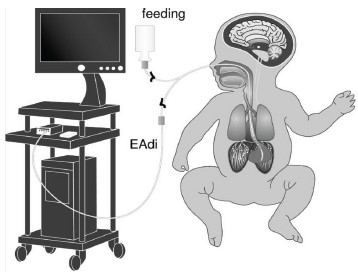
Neurally adjusted ventilatory assist / Respiratory distress syndrome / Preterm infant
[1] Brown MK, DiBlasi RM. Mechanical ventilation of the premature neonate[J].Respir Care, 2011, 56(9): 1298-1311.
[2] Beck J, Campoccia F, AIlo JC, Brander L, Brunet F, Slutsky AS, et al.Improved synchrony and respiratory unloading by neurally adjusted ventilatory assist (NAVA) in lung-injured rabbits[J]. Pediatr Res, 2007, 61(3): 289-294.
[3] Allo JC, Beck JC, Brander L, Brunet F, Slutsky AS, Sinderby CA. Influence of neurally adjusted ventilatory assist and positive end-expiratory pressure on breathing pattern in rabbits with acute lung injury[J]. Crit Care Med, 2006, 34: 2997-3004.
[4] Sinderby C, Beck J, Spahija J, de Marchie M, Lacroix J, Navalesi P, et al. Inspiratory muscle unloading by neurally adjusted ventilatory assist during maximal inspiratory efforts in healthy subjects[J]. Chest, 2007, 131(3): 711-717.
[5] Sweet DG, Carnielli V, Greisen G, Hallman M, Ozek E, Plavka R, et al. 欧洲新生儿呼吸窘迫综合征防治指南-2010版[J].中华儿科杂志, 2011, 49(1): 27-33.
[6] Green ML, Walsh BK, Wolf GK, Arnold JH. Electrocardiographic guidance for the placement of gastric feeding tubes: a pediatric case series[J]. Respir Care, 2011, 56(4): 467-471.
[7] 杜立中. 超低出生体重儿呼吸支持策略及进展[J]. 中国实用儿科杂志, 2012, 27(1): 4-6.
[8] Sinderby C, Navalesi P, Beck J, Skrobik Y, Comtois N, Friberg S, et al.Neural control of mechanical ventilation in respiratory failure[J]. Nature Med, 1999, 5(12): 1433-1436.
[9] Navalesi P, Colombo D, Della CF. NAVA ventilation[J]. Minerva Anestesiol, 2010, 76(5): 346-352.
[10] Beck J, Reilly M, Grasselli G, Qui H, Slutsky AS, Dunn MS, et al. Characterization of neural breathing pattern in spontaneously breathing preterm infants[J]. Pediatr Res, 2011, 70(6): 607-613.
[11] Beck J, Reilly M, Grasselli G, Mirabella L, Slutsky AS, Dunn MS, et al. Patient-ventilator interaction during neurally adjusted ventilatory assist in low birth weight infants[J]. Pediatr Res, 2009, 65(6): 663-668.
[12] Alander M, Peltoniemi O, Pokka T, Kontiokari T. Comparison of pressure-, flow-, and NAVA-triggering in pediatric and neonatal ventilatory care[J]. Pediatr Pulmonol, 2012, 47(1): 76-83.
[13] Stein H, Howard D. Neurally adjusted ventilator assit in neonates weighing <1500 grams: a retrospective analysis[J]. J Pediatr, 2012, 160(5): 786-789.