PDF(2077 KB)

Visualization study of current research on nutrition of premature infants in China
YANG Xiao-Yan, CHEN Chao, TANG Jun, CHEN Da-Peng, MU De-Zhi
Chinese Journal of Contemporary Pediatrics ›› 2013, Vol. 15 ›› Issue (10) : 835-840.
PDF(2077 KB)
 PDF(2077 KB)
Visualization study of current research on nutrition of premature infants in China
OBJECTIVE: Inadequate postnatal nutritional support is an important factor contributing to growth failure, which leads to poor neurological outcome. In this study, co-word analysis was used to investigate the research on nutrition of premature infants over the last six years in China, describe the research trend in this field in China, and provide possible directions for future research. METHODS: A literature search was performed in January 2013 using the CNKI database and the key words “preterm infant” and “nutrition”. A total of 772 articles were retrieved. Then high-frequency key words were extracted using Excel 2010 to create a co-occurrence matrix. Finally, a visualized network was built using Ucinet 6.0. RESULTS: The knowledge domain map of research on nutritional support for premature infants in China showed that the major topic of relevant research is still the combination of parenteral nutrition and enteral nutrition, with the goal of maintaining appropriate growth rates in premature infants. Researchers have paid much attention to the adverse effects of parenteral nutrition. Feeding intolerance is still the main problem in nutritional support, especially enteral nutrition, for premature infants. CONCLUSIONS: A visualized network of current research on nutrition of premature infants in China has been created, and a knowledge domain map has been drawn to reflect the hot topics in this field of study over the last six years.
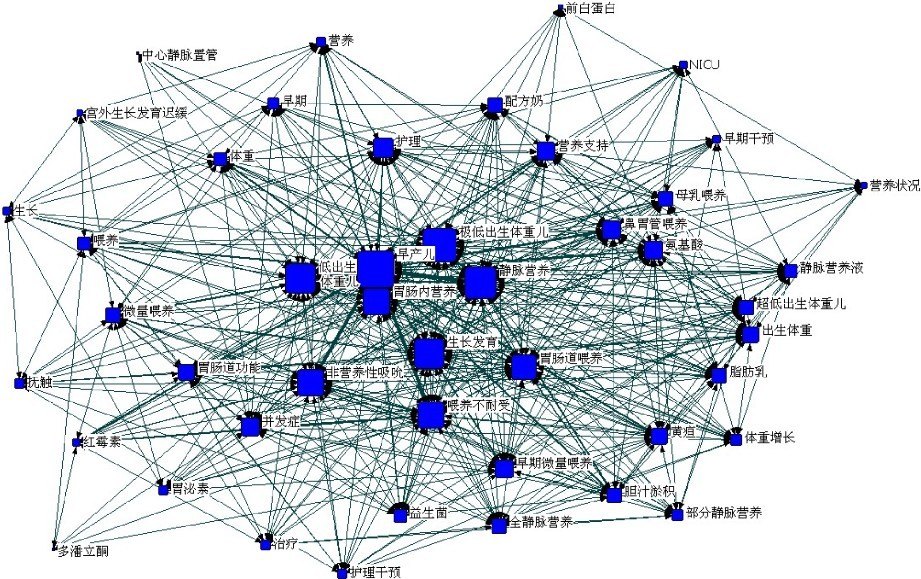
Nutrition / Co-word analysis / Visualization study / Premature infant
[1] Dusick AM, Poindexter BB, Ehrenkranz RA, Lemons JA. Growth failure in the preterm infant: can we catch up?[J]. Semin Perinatol, 2003, 27(4): 302-310.
[2] 中华医学会肠外肠内营养学分会儿科协作组, 中华医学会儿科学分会新生儿学组, 中华医学会小儿外科学分会新生儿学组. 中国新生儿营养支持临床应用指南[J]. 中国当代儿科杂志, 2006, 8(5): 352-356.
[3] 《中华儿科杂志》编辑委员会, 中华医学会儿科学分会新生儿学组. 早产儿管理指南[J]. 中华儿科杂志, 2006, 44(3): 188-191.
[4] 钟伟金, 李佳. 共词分析法研究(一)—共词分析的过程与方式[J]. 情报杂志, 2008, 27(5): 70-72.
[5] 冯璐, 冷伏海. 共词分析方法理论进展[J]. 中国图书馆学报, 2006, 32(162): 88-92.
[6] 秦长江, 侯汉清. 知识图谱—信息管理与知识管理的新领域[J]. 大学图书馆学报, 2009, (1): 30-37, 96.
[7] 储节旺, 郭春侠. EXCEL实现共词分析的方法—以国内图书情报领域知识管理研究为例[J]. 情报杂志, 2011, 30(3): 45-49.
[8] 王宪磊. 信息管理论[M]. 北京:社会科学文献出版社, 2004: 333.
[9] 魏瑞斌. 基于关键词的情报学研究主题分析[J]. 情报科学, 2006, 24(9): 1400-1404, 1434.
[10] 钟伟金, 李佳. 共词分析法研究(二)—类团分析[J]. 情报杂志, 2008, 27(6): 141-143.
[11] Ziegler EE, O'Donnell AM, Nelson SE, Fomon SJ. Body composition of the reference fetus[J]. Growth, 1976, 40(4): 329-41.
[12] Valentine CJ, Fernandez S, Rogers LK, Gulati P, Hayes J, Lore P, et al. Early amino-acid administration improves preterm infant weight[J]. J Perinatol, 2009, 29(6): 428-432.
[13] Uauy R, Hoffman DR. Essential fat requirements of preterm infants[J]. Am J Clin Nutr, 2000, 71(1 suppl): 245S-250S.
[14] Gutcher GR, Farrell PM. Intravenous infusion of lipid for the prevention of essential fatty acid deficiency in premature infants[J]. Am J Clin Nutr, 1991, 54(6): 1024-1028.
[15] Menon G. Neonatal long lines[J]. Arch Dis Child Fetal Neonatal Ed, 2003, 88(4): F260-F262.
[16] Bizzarro MJ, Sabo B, Noonan M, Bonfiglio MP, Northrup V, Diefenbach K, et al. A quality improvement Initiative to reduce central line-associated bloodstream infections in a neonatal intensive care unit[J]. Infect Control Hosp Epidemiol, 2010, 31(3): 241-248.
[17] Zingg W, Tomaske M, Martin M. Risk of parenteral nutrition in neonates—an overview[J]. Nutrients, 2012, 4(10): 1490-1503.
[18] Teitelbaum DH, Tracy TF, Aouthmany JMA, Llanos A, Brown MB, Yu S, et al. Use of cholecystokinin-octapeptide for the prevention of parenteral nutrition-associated cholestasis[J]. Pediatrics, 2005, 115(5): 1332-1340.
[19] Adamkin DH. Total parenteral nutrition-associated cholestasis: prematurity or amino acids?[J]. Journal of Perinatology, 2003, 23(6): 437-438.
[20] 唐振, 周英, 李明霞. 早产儿喂养不耐受临床特征分析[J]. 中国当代儿科杂志, 2011, 13(8): 627-630.
[21] 牛志民. 多潘立酮干预早产儿喂养不耐受30例疗效观察[J]. 新乡医学院学报, 2007, 24(2): 196-198.
[22] Neu J. Gastrointestinal development and meeting the nutritional needs of premature infants[J]. Am J Clin Nutr, 2007, 85(2): 629S-634S.
[23] Patole S, Rao S, Doherty D. Erythromycin as a prokinetic agent in preterm neonates: a systematic review[J]. Arch Dis Child Fetal Neonatal Ed, 2005, 90(4): F301-F306.
[24] Hay Jr WW. Strategies for feeding the preterm infant[J]. Neonatology, 2008, 94(4): 245-254.
[25] 岳晓红, 赵翠霞, 芦惠, 薛辛东. 非营养性吸吮对早产儿营养及胃肠道转运时间的影响[J].中华儿科杂志, 2003, 41(2): 91-94.
[26] Tsang RC, Unany R, Koletzko B, Zlotkin SH主编; 毛萌, 姚裕家,母得志,杨帆主译.早产儿营养:基础与实践指南[M]. 北京:人民卫生出版社, 2008: 1-16