PDF(1004 KB)
 PDF(1004 KB)
 PDF(1004 KB)
晚期早产儿—大自然未完成的杰作
Late preterm infant——Nature’s unfinished master piece
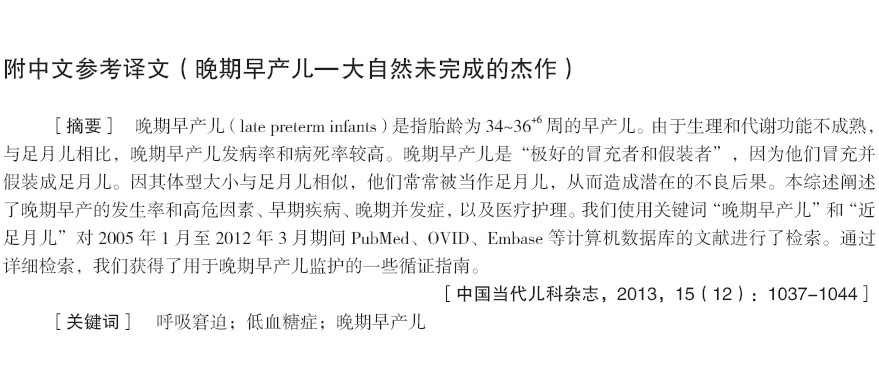
晚期早产儿(late preterm infants)是指胎龄为34~36+6周的早产儿。由于生理和代谢功能不成熟,与足月儿相比,晚期早产儿发病率和病死率较高。晚期早产儿是“极好的冒充者和假装者”,因为他们冒充并假装成足月儿。因其体型大小与足月儿相似,他们常常被当作足月儿,从而造成潜在的不良后果。本综述阐述了晚期早产的发生率和高危因素、早期疾病、晚期并发症,以及医疗护理。我们使用关键词“晚期早产儿”和“近足月儿”对2005年1月至2012年3月期间PubMed、OVID、Embase等计算机数据库的文献进行了检索。通过详细检索,我们获得了用于晚期早产儿监护的一些循证指南。
Late preterm infants (LPI) are preterm infants born at a gestational age between 34 and 0/7 weeks to 36 6/7 weeks. Because of their physiologic and metabolic immaturities, they are at increased risk for a spectrum of morbidities and mortality when compared to the term infants. LPI are "great pretenders and masqueraders", as they pretend to be and masquerading as term infants. Because of their size, frequently they are treated as term infants with potential for bad consequences. In this review, the incidence and high risk factors for late preterm deliveries, early morbidities, late complications and management are described. Computerized data bases such as PubMed, OVID and Embase were searched between January 2005 and March 2012, by using the search terms, Late Preterm Infants and Near Term Infants. From this detailed search available, evidence based guidelines were incorporated in the care of these LPI.