新生儿难治性惊厥STXBP1基因突变的研究

刘黎黎, 侯新琳, 周丛乐, 汤泽中, 包新华, 姜毅

中国当代儿科杂志 ›› 2014, Vol. 16 ›› Issue (7) : 701-704.

PDF(1302 KB)
HTML
PDF(1302 KB)
HTML
中国当代儿科杂志 ›› 2014, Vol. 16 ›› Issue (7) : 701-704. DOI: 10.7499/j.issn.1008-8830.2014.07.009
论著·临床研究

新生儿难治性惊厥STXBP1基因突变的研究

  • 刘黎黎, 侯新琳, 周丛乐, 汤泽中, 包新华, 姜毅
作者信息 +

STXBP1 gene mutation in newborns with refractory seizures

  • LIU Li-Li, HOU Xin-Lin, ZHOU Cong-Le, TANG Ze-Zhong, BAO Xin-Hua, JIANG Yi
Author information +
文章历史 +

摘要

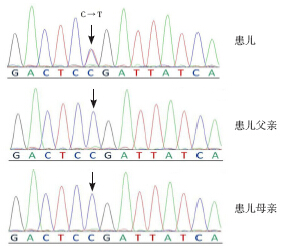
目的 探讨STXBP1 基因突变与不明原因新生儿难治性惊厥的关系。方法 应用直接测序法对11 例原因不明的新生儿难治性惊厥患儿进行STXBP1 编码区的突变检测。结果 11 例患儿中,1 例检测到STXBP1 基因突变。突变类型为错义突变,突变位点c.1439C>T(p.P480L)。结论 在新生儿难治性惊厥患儿中,可检测到STXBP1 基因突变,为该类疾病的深入研究提供了新的思路。

Abstract

Objective To study the relationship between STXBP1 gene mutations and refractory seizures with unknown causes in newborns. Methods The coding region of STXBP1 gene was detected using direct Sanger sequencing in 11 newborns with refractory seizures of unknown causes. Results STXBP1 gene mutation was found in 1 out of 11 patients. It was a missense mutation: c.1439C>T (p.P480L). Conclusions STXBP1 gene mutation can be found in neonatal refractory seizures of unknown causes, suggesting a new approach of further research of this disease.
关键词

难治性惊厥 / STXBP1 / 基因突变 / 新生儿

Key words

Refractory seizure / STXBP1 / Gene mutation / Newborn

引用本文

导出引用
刘黎黎, 侯新琳, 周丛乐, 汤泽中, 包新华, 姜毅. 新生儿难治性惊厥STXBP1基因突变的研究[J]. 中国当代儿科杂志. 2014, 16(7): 701-704 https://doi.org/10.7499/j.issn.1008-8830.2014.07.009
LIU Li-Li, HOU Xin-Lin, ZHOU Cong-Le, TANG Ze-Zhong, BAO Xin-Hua, JIANG Yi. STXBP1 gene mutation in newborns with refractory seizures[J]. Chinese Journal of Contemporary Pediatrics. 2014, 16(7): 701-704 https://doi.org/10.7499/j.issn.1008-8830.2014.07.009

参考文献

[1] 刘黎黎, 周丛乐, 侯新琳. 新生儿难治性惊厥的研究进展[J]. 中国当代儿科杂志, 2011, 13(1): 77-81.
[2] Bassan H, Ental Y, Shany E, et al. Neonatal seizures: dilemmas in workup and management[J]. Pediatr Neurol, 2008, 38(6): 415-421.
[3] Garcias Da Silva LF, Nunes ML, Da Costa JC. Risk factors for developing epilepsy after neonatal seizures[J]. Pediatr Neurol, 2004, 30(4): 271-277.
[4] Ramos LJ, Aguilera LP, Aguirre R, et al. Early prediction of refractory epilepsy in childhood[J]. Seizure, 2009, 18(6): 412-416.
[5] Milh M, Villeneuve N, Chouchane M, et al. Epileptic and nonepileptic features in patients with early onset epileptic encephalopathy and STXBP1 mutations[J]. Epilepsia, 2011, 52(10): 1828-1834.
[6] Saitsu H, Kato M, Okada I, et al. STXBP1 mutations in early infantile epileptic encephalopathy with suppression-burst pattern[J]. Epilepsia, 2010, 51(12): 2397-2405.
[7] Rizo J, Rosenmund C. Synaptic vesicle fusion [J]. Nat Struct Mol Biol, 2008, 15(7): 665-674.
[8] Wojcik SM, Brose N. Regulation of membrane fusion in synaptic excitation-secretion coupling: speed and accuracy matter[J]. Neuron, 2007, 55(1): 11-24.
[9] Burkhardt P, Hattendorf DA, Weis WI, et al. Munc18a controls SNARE assembly through its interaction with the syntaxin N-peptide[J]. Embo J, 2008, 27(7): 923-933.
[10] Saitsu H, Kato M, Mizuguchi T, et al. De novo mutations in the gene encoding STXBP1 (MUNC18-1) cause early infantile epileptic encephalopathy[J]. Nat Genet, 2008, 40(6): 782-788.
[11] Shen J, Tareste DC, Paumet F, et al. Selective activation of cognate SNAREpins by Sec1/Munc18 proteins[J]. Cell, 2007, 128(1): 183-195.
[12] Deprez L, Weckhuysen S, Holmgren P, et al. Clinical spectrum of early-onset epileptic encephalopathies associated with STXBP1 mutations[J]. Neurology, 2010, 75(13): 1159-1165.
[13] Hamdan FF, Piton A, Gauthier J, et al. De novo STXBP1 mutations in mental retardation and nonsyndromic epilepsy[J]. Ann Neurol, 2009, 65(6): 748-753.
[14] Otsuka M, Oguni H, Liang JS, et al. STXBP1 mutations cause not only Ohtahara syndrome but also West syndrome-result of Japanese cohort study[J]. Epilepsia, 2010, 51(12): 2449-2452.
[15] Mignot C, Moutard ML, Trouillard O, et al. STXBP1-related encephalopathy presenting as infantile spasms and generalized tremor in three patients[J]. Epilepsia, 2011, 52(10): 1820-1827.
[16] Chelly J, Khelfaoui M, Francis F, et al. Genetics and pathophysiology of mental retardation[J]. Eur J Hum Genet, 2006, 14(6): 701-713.
[17] Zoghbi HY. Postnatal neurodevelopmental disorders: meeting at the synapse?[J]. Science, 2003, 302(5646): 826-830.
[18] Hamdan FF, Gauthier J, Dobrzeniecka S, et al. Intellectual disability without epilepsy associated with STXBP1 disruption[J]. Eur J Hum Genet, 2011, 19(5): 607-609.
[19] Archer HL, Evans J, Edwards S, et al. CDKL5 mutations cause infantile spasms, early onset seizures, and severe mental retardation in female patients [J]. J Med Genet, 2006, 43(9): 729-734.
[20] Weaving LS, Christodoulou J, Williamson SL, et al. Mutations of CDKL5 cause a severe neurodevelopmental disorder with infantile spasms and mental retardation [J]. Am J Hum Genet, 2004, 75(6): 1079-1093.
[21] Tao J, Van Esch H, Hagedorn-Greiwe M, et al. Mutations in the X-linked cyclin-dependent kinase-like 5 (CDKL5/STK9) gene are associated with severe neurodevelopmental retardation[J]. Am J Hum Genet, 2004, 75(6): 1149-1154.
[22] Scala E, Ariani F, Mari F, et al. CDKL5/STK9 is mutated in Rett syndrome variant with infantile spasms[J]. J Med Genet, 2005, 42(2): 103-107.
[23] Rosas-Vargas H, Bahi-Buisson N, Philippe C, et al. Impairment of CDKL5 nuclear localization as a cause for severe infantile encephalopathy [J]. J Med Genet, 2008, 45(3): 172-178.
[24] Pavone P, Spalice A, Polizzi A, et al. Ohtahara syndrome with emphasis on recent genetic discovery [J]. Brain Devel, 2012, 34(6): 459-468.
[25] Kato M, Saitoh S, Kamei A, et al. A longer polyalanine expansion mutation in the ARX gene causes early infantile epileptic encephalopathy with suppression-burst pattern (Ohtahara syndrome)[J]. Am J Hum Genet, 2007, 81(2): 361-366.
[26] Kato M, Das S, Petras K, et al. Polyalanine expansion of ARX associated with cryptogenic West syndrome[J]. Neurology, 2003, 61(2): 267-276.

PDF(1302 KB)
HTML

Accesses

Citation

Detail

段落导航
相关文章

/